Custom Search

Monday, February 26, 2007

It's on!


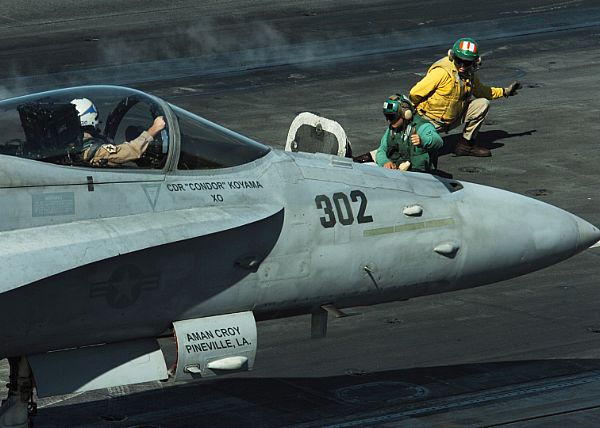
The USS Stennis is in the Arabian Sea and began conducting combat missions in Afghanistan. The Stennis left its homeport in Washington state in January and arrived to support the War on Terrorism last week. The Stennis is a Nimitz class aircraft carrier and can carry up to 85 aircraft.


"Operating in the North Arabian Sea, USS John C. Stennis (CVN 74) launched an F/A-18C Hornet from the “Death Rattlers” of Marine Strike Fighter Squadron (VMFA) 323, beginning the strike group’s first combat mission in support of Operation Enduring Freedom."


The Stennis and its support group is no doubt a welcome addition to the area to assist with operations there. Just keep in mind that where ever there is a US aircraft carrier, there is most likely also a Los Angeles class attack submarine somewhere in the area. They can also do plenty of damage on their own!


Thursday, February 22, 2007

A Solution for Global Warming? A New Cold War

This article speaks for itself, so I have reprinted it for your convenience. It seems to me that relations between the US and Russia have been tense lately over Iraq and Iran and may be starting to cool off.

Russia Plans New ICBMs, Nuclear Subs

By VLADIMIR ISACHENKOV, Associated Press Writer
Wednesday, February 7, 2007

(02-07) 10:02 PST MOSCOW, Russia (AP) --
Russia's defense minister on Wednesday laid out an ambitious plan for building new intercontinental ballistic missiles, nuclear submarines and possibly aircraft carriers, and set the goal of exceeding the Soviet army in combat readiness.
Sergei Ivanov's statements appeared aimed at raising his profile at home ahead of the 2008 election in which he is widely seen as a potential contender to succeed President Vladimir Putin. But they also seemed to reflect a growing chill in Russian-U.S. relations and the Kremlin's concern about U.S. missile defense plans.
Ivanov told parliament the military would get 17 new ballistic missiles this year — a drastic increase over the average of four deployed annually in recent years. The purchases are part of a weapons modernization program for 2007-2015 worth about $190 billion.
The plan envisages the deployment of 34 new silo-based Topol-M missiles and control units, as well as an additional 50 such missiles mounted on mobile launchers by 2015; Russia so far has deployed more than 40 silo-based Topol-Ms.
Putin and other officials have described the Topol-M as a bulwark of Russia's nuclear might for years to come, and said it can penetrate any prospective missile defenses. Last week, Putin dismissed U.S. claims that missile defense sites Washington hopes to establish in Poland and the Czech Republic were intended to counter threats from Iran, and said Russia would respond by developing more efficient weapons systems.
In 2002, Putin and President Bush signed a treaty obliging both sides to cut their strategic nuclear weapons by about two-thirds by 2012, down to 1,700 to 2,200 missiles. But Russian-U.S. ties have since worsened steadily over disagreements on Iraq and other global crises, and U.S. concerns about an increasingly authoritarian streak in Russia's domestic policy.
"The Russian leadership believes that a nuclear parity with the United States is vitally important because it allows it to conduct an equal dialogue on other issues," said an independent military analyst, Alexander Golts.
A rising tide of oil revenues has enabled Russia to boost defense spending following a squeeze on the military in the 1990s. "The question now is whether the industries are capable of producing what the military needs," Ivanov said.
Analysts warn that building any sizable numbers of new weapons would pose a daunting challenge to the defense plants that received virtually no government orders for a decade following the 1991 Soviet collapse.
"Links to subcontractors have been broken, and the defense plants now need to rebuild them to produce weapons," Golts said.
Alexander Pikayev, a senior analyst at the Moscow-based Institute for World Economy and International Relations, said the military had failed to set the right priorities for weapons procurement in the past.
Russia's defense budget, which stood at $8.1 billion in 2001, nearly quadrupled to $31 billion this year, Ivanov said. While this year's military spending is Russia's largest since the 1991 Soviet collapse, it is still about 20 times less than the U.S. defense budget.
Ivanov said the military now has enough money to intensify combat training.
"Combat readiness of the army and the navy is currently the highest in the post-Soviet history," he said, adding the task now is to "exceed Soviet-era levels."
Ivanov said the military now has about 1.13 million servicemen, compared with 1.34 million in 2001. By 2015, the military plans to have about 1 million servicemen as Russia continues to reduce its bloated armed forces. "We can't go below that," he said.
The Kremlin has rejected liberals' calls to abolish the draft, saying Russia needs a large number of conscripts to protect its huge territory.

Ivanov said the weapons modernization program would allow the military to replace 45 percent of existing arsenals with modern weapons systems by 2015.
As part of the plan, the navy will commission 31 new ships, including eight nuclear submarines carrying intercontinental ballistic missiles, Ivanov said.
He played down recent failed launches of the Bulava missile being developed to equip these submarines. The Bulava, developed by the same design bureau that built the Topol-M, failed in three consecutive launches late last year.
"If we already had commissioned this missile and had failures, that would have been a nightmare," Ivanov said, adding that launch failures were "within the norm" in the testing phase.
He also said the government would decide in 2009-2010 whether to start the construction of a new shipyard for building aircraft carriers. Russia now only has one Soviet-built medium-sized aircraft carrier capable of carrying about 30 jets and helicopters.

Tuesday, February 20, 2007

Beefing Up


Apparently Venezuela is trying to beef up its submarine fleet. It is taking bids from France, Germany and Russia to buy 9 additional diesel powered submarines. It currently has 2 submarines that it acquired from Germany in 1972, that are over 30 years old. With these nine additional subs, it would have the largest submarine force in South America. Chavez seems to be gearing up in case of a conflict with the U.S. I could be wrong, but I don't expect the U.S. to invade Venezuela anytime soon. Chavez seems to think that he is more important than he really is. It looks like he is trying to provoke the U.S. into a conflict with him. I do have to admit that diesel boats are pretty quiet, but they are severely disadvantaged when up against the submarines we currently have in our fleet. Diesel subs for one run on their batteries when submerged, which need to be recharged by the very loud diesel generator every once in awhile. They are also slower and cannot carry the payload that U.S. subs can. With the L.A. class subs and the new, highly technological Virginia class subs, Chavez doesn't stand a chance. All we would have to do is stay quiet and wait for his subs to surface to recharge the batteries, and bye-bye Venezuelan sub fleet.

Wednesday, February 14, 2007

New Anti-Terrorism Weapons

The Navy has been training dolphins and sea lions to detect potential threats in the water. The base in Bangor, Washington is home to submarines, ships and labs that are potential targets for terrorist. The USS Louisiana, my old boat, just relocated there from Kings Bay, GA not too long ago. Apparently these animals have been deployed to Kings Bay. They have been used before for security in the US, and to patrol the port waters in the Gulf. Not only are these specially trained dolphins able to detect a person, but they can find mines as well. The sea lions even carry cuffs in their mouths that they can use to haul in potential threats! Animal Rights activists claim this is not a good idea, but it is a good way to deter potential attacks, because threats will not know if there are any trained dolphins or sea lions patrolling the waters. The Navy has been doing this since th 60's and treats the animals well. Until something else comes along this is just one way to keep potential threats away.

Saturday, February 10, 2007

A Story of Sacrifice

A North Carolina based Navy Corpsman was killed in Iraq, just 7 days after he arrived there. The story is reprinted below for you convenience.

EL PASO, Texas — A North Carolina-based Navy corpsman told his brother that if he died in Iraq, he wanted his two children to know he served so they could grow up free and without fear.
Navy Petty Officer 1st Class Gilbert Minjares Jr., 31, died Wednesday - seven days after he reached Iraq - in a helicopter crash in Anbar province, the Department of Defense said Friday. Six others also died in the crash, which is under investigation.
"He gave me all his clothes and stuff, like he knew what was going to happen," said Jose Minjares, Gilbert's brother. "He told me, 'If anything happens, I want you to let my kids know I did it for them.'"
Minjares was assigned to Marine Aircraft Group 14, 2nd Marine Aircraft Wing in Cherry Point, North Carolina His wife, 2-year-old son and 4-week-old baby live in North Carolina, said Eddie Pedregon, the seaman's cousin.
"He always wanted to give to others before he gave to himself," Pedregon said. "His dream was to save Marines."
A corpsman is the Marines' equivalent of an Army medic. Gilbert Minjares also worked as a recruiter in El Paso, Jose Minjares said.
Minjares played fullback and quarterback at Hanks High School in El Paso. He joined the Navy about a month after graduating in 1994, his brother said.
The seaman was happy-go-lucky, loved his family and his home and had no doubts about his service or heading to Iraq, his brother said.
"He said he'd rather go fight over there than have to fight (terrorism) over here," the brother said. "He was a brave, brave man."

Friday, February 09, 2007

Drug Raid!


"USS McInerney (FFG 8) added to its string of successes on her counter-narco terrorism (CNT) deployment by supporting the seizure of 2.3 metric tons of cocaine in mid-January from a fishing vessel off the coast of Costa Rica." According to this article, the US Navy teamed up with Costa Rica for the first time to thwart the transport of drugs. The USS McInerney is a Guided Missile Frigate, currently serving out of Mayport, FL. Frigates are just under 500 feet long and are armed with Harpoon missiles, MK-46 torpedos, one 76 mm (3-inch)/62 caliber MK 75 rapid fire gun, and one Phalanx close-in-weapons system. I think it is safe to say that the McInerney is well equipped for this type of mission.
Lt. Erik Bodiscomassink, McInerney’s Engineering Officer and a Tactical Action Officer (TAO), said “Any time you approach a vessel, you’re not quite sure what you’re going to encounter. Part of you always wonders what their intentions are. Just get as much information as you can and rely on your training.”
BZ to the hard work of the USS McInerney, the US Coast Guard and their Costa Rican counter-parts. It is successes like these that keep tons of cocaine off the streets!

Wednesday, January 31, 2007

Update on the Collision in the Gulf

The Captain of the USS Newport News has been removed from duty after the sub collided with a Japanese tanker in the Gulf. The following is a press release from the 5th Fleet Public Affairs Office:

BAHRAIN - Rear Adm. Douglas J. McAneny, Commander, Combined Task Force 54, completed administrative personnel actions involving select members of the USS Newport News (SSN 750) crew, Monday, Jan. 29, to include relieving Cmdr. Matthew A. Weingart of command due to a lack of confidence in his ability to command. Capt. Norman B. Moore has temporarily assumed command of the Los Angeles-class fast attack submarine.

Following a collision between Newport News and M/V Mogamigawa, Jan. 8, the submarine transited to Bahrain where it is currently undergoing a damage inspection and assessment, to be followed by temporary repairs. The submarine will return to the United States once temporary repairs are complete; at which time permanent repairs will be conducted. Legal and Safety Mishap investigations are in progress.

As a general rule Captains of submarines and any ships in the Navy are held responsible for any "mishaps" that might occur. I thought that it was interesting that the Admiral had a "lack of confidence in his ability to command." It makes me wonder if during the invesitgation if other things came to light about his Leadership abilities. I am not saying that the CO is incompetent, it was just an interesting choice of words.

Monday, January 29, 2007

USS Perch Discovered in 190 feet of Water

The USS Perch (SS 176) was discovered in about 190 feet of water in the Java Sea 60 years or so after the sub sunk in WWII. There has not been an official announcement from the Navy as of yet, but as you can see in the picture above there is little room for doubt that this is the boat. What is so special about the Perch from other subs that sunk in WWII? Well, read this and see that the Perch was not like most of the subs whose final hours are unknown but it is known that the sub was scuttled by the crew:

After a week of close contact with the enemy, obtaining information, Perch headed south searching for targets. In a night attack on a large merchantman off the eastern coast of Sulawesi (Celebes), Perch was hit in the superstructure, forward of the pressure hull of the conning tower, by a high explosive projectile which blew away the bridge deck, punctured the antenna trunk and temporarily put her radio out of commission. Efforts of her crew made repairs on deck at night in waters heavily patrolled by the enemy, and Perch headed for the Java Sea.

On the evening of 1 March 1942, Perch surfaced thirty miles (55 km) northwest of Soerabaja, Java, Netherlands East Indies, and started in for an attack on the enemy convoy that was landing troops to the west of Soerabaja. Two enemy destroyers attacked and drove her down with a string of depth charges which caused her to bottom at 135 feet (41 m). Several more depth charge attacks caused extensive damage, putting the starboard motors out of commission and causing extensive flooding throughout the boat. After repairs, Perch surfaced at two o'clock in the morning only to be again driven down by the enemy destroyers. The loss of oil, and air from damaged ballast tanks, convinced the enemy that Perch was breaking up and they went on to look for other kills, allowing Perch to surface.

With the submarine's decks awash and only one engine in commission, the crew made all possible repairs. During the early morning of 3 March, a test dive was made with almost fatal results. Expert handling and good luck enabled her to surface from that dive, only to find herself under the guns of two Japanese cruisers and three destroyers. As shells straddled the boat, the commanding officer ordered "abandon ship." With all hull openings open, Perch made her last dive. She was struck from the Naval Vessel Register 24 June 1942.

The entire crew was captured by a Japanese destroyer. Of the fifty-four men and five officers, only six, who died of malnutrition in Japanese prisoner-of-war camps, were unable to return to the United States after V-J Day.


Saturday, January 27, 2007

Emergency Blow!

If you have ever wondered what an Emergency Blow/Surface looks like or have wondered if it looks the way it does on tv, check out the short clip below. The sub in the video is a Fast Attack, Los Angeles Class, submarine. I was able to experience this maneuver several times while on the USS Louisiana. It is a pretty cool feeling and a fun experience. If you ever get invited on a "Tiger Cruise" for a submarine, go. They usually do one of these for the guests and family and it is a lot of fun!

Wednesday, January 24, 2007

Weapons 101 - Part II


Well, here is the next in my series on Weapons. The Navy recently successfully tested a Rail gun. For those of you who aren't familiar with how a rail gun works, here is a short definition from Wikipedia:
A railgun is a form of gun that converts electrical energy (rather than the more conventional chemical energy from an explosive propellant) into projectile kinetic energy. It is not to be confused with a coilgun (Gauss gun).
Not only is this very cool technology, but it is safer,cheaper and will make warships firing from the sea more effective. With conventional type guns Navy ships can only fire about 15 miles, not including Tomahawk missiles which can go further. These rail guns can fire the equivalent of a Ford Taurus about 200 miles at a speed of around 380 mph! The rail gun projectiles do not even require an explosive to detonate upon impact. The force behind them is so great they can do plenty of damage without a warhead, even bring down buildings. I look forward to seeing improvements on the prototype and watching them in action against certain "enemy combatants".

Wednesday, January 10, 2007

Big Zoof! Who knew?

I was waiting to see what the US Navy would say about the story involving a US submarine, USS Newport News, colliding with a Japanese tanker before I threw in my 2 cents. Well, here is the Navy's response according to the Virginia Pilot:
----------------------------------------------------------------------------------
The submarine Newport News was submerged and leaving the Persian Gulf when a mammoth Japanese oil tanker passed overhead at a high speed, creating a sucking effect that made the sub rise and hit the ship, the Navy said Tuesday.

That is the preliminary finding of Monday's collision between the Norfolk-based submarine and the Mogamigawa, a 1,100-foot-long merchant ship displacing 300,000 tons.
Both were southbound, crossing the busy and narrow Strait of Hormuz while heading into the Arabian Sea.


"As the ship passed over the sub, it ended up sucking the submarine into it," said Lt. Cmdr. Chris Loundermon, a spokesman for Submarine Force in Norfolk.
"It is a principle called the venturi effect," he said.

----------------------------------------------------------------------------------
You can read about the Venturi effect here. Basically when the large supertanker zoofed (submarine slang for a surface ship passing directly over a submarged submarine), the size and speed of the tanker caused a drop in pressure in the water above the sub and caused it to be forced toward the surface. The explanation is certainly possible, although this is the first time I have ever heard of it happening. There have been other instances of subs being forced to the surface through other circumstances, but as there are no references on the internet that I can find, you will just have to take my word for it! I am not sure how this will affect the CO and crew of the Newport News yet, but if the explanation is accepted, they may be ok. Most people do not understand the dynamics of operating a submarine and the forces that can potentially act on it, so it may be a tough sell to the general public. The sub is on its way to port for inspection so we may be seeing some pictures of the damage in the near future. I will keep an eye out for them.

Submarine slang word of the day: Zoof

Thursday, January 04, 2007

Weapons 101 - Part I


I have mentioned a couple of the weapons (on submarines in particular) available to the US Navy in previous posts. I decided I would post a few of the other weapons systems out there that are pretty amazing. I am starting with the Phalanx - Close-in Weapons System (referred to in the fleet as CIWS, pronounced C-Wiz). These are used on surface ships as a last chance weapon against anti-ship missiles and small targets that have gotten a little too close (including small boats, helicopters and mines).

They detect and track their targets and can spew out 4,500 rounds (20mm) per minute (that's 75 rounds per second for you mathematically challenged out there)! That can definitely tear something to pieces in a matter of seconds. Here are the General Characteristics from the official Navy Fact File:

Primary Function: Anti-ship missile defense.
Contractor: Raytheon Systems Company (formerly Hughes Missile Systems Company and purchased from General Dynamics Pomona Division in 1992)
Date Deployed: 1980 (aboard USS Coral Sea)Block 1: 1988 (aboard USS Wisconsin)Block 1B: 1999 (aboard USS Underwood)
Weight: 12,500 pounds (5,625 kg) - Later models: 13,600 pounds (6,120 kg).
Range: Classified.
Type Fire: 3,000 rounds per minute - Later models: 4,500 rounds/min (starting 1988 production, Pneumatic Gun Drive).
Magazine Capacity: 989 rounds - Later models: 1,550 rounds.
Caliber: 20mm.
Ammunition: Armor Piercing Discarding Sabot, depleted uranium sub-caliber penetrator. Penetrator changed to tungsten 1988. Block 1B will incorporate the new Enhanced Lethality Cartridge with heavier penetrator.
Type: M-61A1 Gatling Gun.

Now, see it in action:


Monday, January 01, 2007

The Best of the Best


45 years ago today, SEAL Teams ONE (Pacific Fleet) and TWO (Atlantic Fleet) were comissioned to "conduct unconventional warfare, counter-guerilla warfare and clandestine operations in both blue and brown water environments." In May of 1961, President Kennedy, addressed Congress in order to established Special Warfare Teams in the US Navy. In December, Congress approved them and the rest is history. SEALs have played significant roles in major conflicts throughout the world. The problem is that the public really does not hear that much about their involvement because of the secrecy surrounding their operations. Here is a little about what they do from the official Navy SEAL website:

Special Operations is characterized by the use of small units with unique ability to conduct military actions that are beyond the capability of conventional military forces. SEALs are superbly trained in all environments, and are the master's of maritime Special Operations. SEALs are required to utilize a combination of specialized training, equipment, and tactics in completion of Special Operation missions worldwide.
A tactical force with strategic impact, NSW mission areas include unconventional warfare, direct action, combating terrorism, special reconnaissance, foreign internal defense, information warfare, security assistance, counter-drug operations, personnel recovery and hydrographic reconnaissance. Although NSW personnel comprise less than one percent of U.S. Navy personnel, they offer big dividends on a small investment. SEALs' proven ability to operate across the spectrum of conflict and in operations other than war in a controlled manner, and their ability to provide real time intelligence and eyes on target, offer decision makers immediate and virtually unlimited options in the face of rapidly changing crises around the world.
The most important trait that distinguishes Navy SEALs from all other military forces is that SEALs are maritime special forces, as they strike from and return to the sea. SEALs (Sea, Air, Land) take their name from the elements in and from which they operate. Their stealth and clandestine methods of operation allow them to conduct multiple missions against targets that larger forces cannot approach undetected.

Wednesday, December 27, 2006

Torpedo in the Water!

This is a video of an Australian submarine test firing a torpedo at a abandoned Navy ship. For those of you who do not know, a torpedo does not actually strike the ship. They are designed to detonate underneath a ship and vaporize the water supporting the hull. The ship then breaks in two and sinks. This process is clearly seen in the video. Check it out:


Monday, December 18, 2006

Interesting story

Discovered this news story today and thought it was pretty interesting. I reprinted it below for your convenience.

India this week is to begin assembling Franco-Spanish Scorpene attack submarines as part of plan to boost its naval power and military-industrial know-how.

Indian navy Vice Admiral S.K.K. Krishnan, the head of Mumbai's Mazagaon Dock naval shipyard, said production is slated to begin on Thursday, with Defence Minister A.K. Antony set to formally inaugurate the project the following day.

The 2.4 billion euro deal to build an initial six diesel submarines was signed in October 2005 with Armaris, a subsidiary of France's Thales group and Direction des Constructions Navales (DCN).

The agreement also includes the sale of 36 Exocet-type anti-submarine and anti-ship missiles.

"We hope we can commence the production of the Scorpene on the 14th of December. But this is only phase one. We plan to build 18 more indigenous submarines," Krishnan told reporters.

The Scorpene, jointly developed by DCN and Spain's Navantia, is a 67-metre-long (220 feet) craft designed for attack and interception. Malaysia and Chile have also placed orders.

India's contract covers a 12-year period, and the first craft is scheduled to enter into service in 2012, with an additional submarine following each year.

India's navy currently has 16 submarines, but these are mainly ageing Russian and German models. With the Scorpene, India is hoping to bring its fleet up to date to match challenges from rivals Pakistan and China.

The contract also includes the transfer of key technology, with just the first two submarines being built under French and Spanish supervision. The arrangement has been presented as a win-win deal giving new technology to India and a major foothold in the country's huge defence market to the foreign firms.

"It's an innovative technology transfer, with the indigenisation of sub-systems, equipment and components," said Amaris' project director Xavier Marchal.

"In the future there will be good deals to be made in India. This serves as a foundation for DCN's industrial relations at a moment when India's defence economy is transforming," he said.

India is the largest arms purchaser among emerging nations and said last month that it will not prune defence spending because of the growing threat from terrorism and ongoing regional tensions.

India annually spends 14 billion dollars, or 2.34 percent of its gross domestic product, on its military. Since 2004 it has either spent or committed billions of dollars in modernisation projects planned until 2010.

But the Scorpene deal has been marred by corruption allegations.

The main opposition party, the Hindu nationalist Bharatiya Janata Party (BJP), alleged that around four percent of the contract amount -- or around 100 million dollars -- was paid to Indian intermediaries, one of whom is said to be close to the ruling Congress party.

The charges came after weekly magazine Outlook published a series of articles alleging that French defence giant Thales paid the commission to Indian middlemen to clinch the deal.

Thales as well as the French and Indian governments have denied the allegations.

Thursday, December 14, 2006

How to Simulate Life on a Submarine at Home

Here are some things you can do to see what it would be like to live on a submarine without actually having to join the Navy:

1. Obtain a dumpster. Paint it black, weld all the covers shut except one which can be bolted closed from the inside. Hitch it to the back of your wife's mini van. Gather 12 friends and bolt yourselves inside and let your wife pull it around for several weeks while she does the errands.

2. Sleep on the shelf in your closet. Replace the closet door with a curtain. Six hours after you go to sleep, have your wife whip open the curtain. shine a flashlight in your eyes, and mumble "Sorry, wrong rack".

3. Don't eat any food that you don't get out of a can or have to add water to.

4. Paint all the windows on your car black. Drive around town at high speeds with your wife standing up in the sunroof shouting course and speed directions to you.

5. Renovate your bathroom. Build a wall across the middle of your bathtub and move the shower head down to chest level. When you take showers, make sure you shut off the water while soaping.

6. Repeat back everything anyone says to you.

7. Sit in your car for six hours a day with your hands on the wheel and the motor running, but don't go anywhere.

8. Put lube oil in your humidifier instead of water and set it to "High".

9. Don't watch T.V. except movies in the middle of the night. Also, have your family vote on which movie to watch, then show a different one. Record The Sound of Music and show it at least every other night.

10. Don't do your wash at home. Gather your neighbors clothes along with yours, pick the most crowded laundromat you can find, and do the neighborhood laundry in a single washer and dryer. Make sure that 12% of the laundry is lost and 20% of the finished laundry is incorrectly distributed to the wrong neighbor.

11. Leave lawnmower running in your living room six hours a day for proper noise level. (For Engineering Divisions)

12. Have the paperboy give you a haircut.

13. Take hourly readings on your electric and water meters.

14. Sleep with your dirty laundry.

15. Invite guests, but don't have enough food for them.

16. Buy a broken exercise bicycle and strap it down to the floor in your kitchen.

17. Buy a trash compactor and use it once a week. Store up garbage in the other side of your bathtub.

18. Wake up every night at midnight and have a peanut butter and jelly sandwich on stale bread, if anything. (Optional--canned ravioli, cold soup, or cherry peppers)

19. Make up your family menu a week ahead of time without looking in your food cabinets or refrigerator.

20. Set your alarm clock to go off at random times during the night. When it goes off, jump out of bed and get dressed as fast as you can, then run out into your yard and break out the garden hose.

21. Once a month take every major appliance completely apart and then put them back together.

22. Use 18 scoops of coffee per pot and allow it to sit for 5 or 6 hours before drinking.

23. Invite at least 85 people you don't really like to come and visit for a couple of months.

24. Store your eggs in your garage for two months and then cook a dozen each morning.

25. Have a fluorescent lamp installed on the bottom of your coffee table and lie under it to read books.

26. Periodically check your refrigerator compressor for "sound shorts".

27. Put a complicated lock on your basement door and wear the key on a lanyard around your neck.

28. Lockwire the lugnuts on your car.

29. When making cakes, prop up one side of the pan while it is baking. Then spread icing really thick on one side to level off the top.

30. Every so often, yell "Emergency Deep", run into the kitchen, and sweep all pots/pans/dishes off of the counter onto the floor. Then, yell at your wife for not having the place "stowed for sea".

31. Put on the headphones from your stereo (don't plug them in). Go and stand in front of your stove. Say (to nobody in particular) "Stove manned and ready". Stand there for 3 or 4 hours. Say (once again to nobody in particular) "Stove secured". Roll up the headphone cord and put them away.

32. Write a controlled work package to change the oil on your car.

Wednesday, December 13, 2006

Reinforcements

The USS Dwight D Eisenhower, a nuclear powered Aircraft Carrier, commissioned in 1977, has arrived in the Persian Gulf. The linked news story states that it is accompanied by a guided missile cruiser, the USS Anzio on a regular deployment to the Gulf. A Carrier always goes out accompanied by several ships in it's Carrier Strike Group (CSG). Along with these two is Carrier Air Wing (CVW) 7, and embarked Destroyer Squadron (DESRON) 28; guided-missile destroyers USS Ramage (DDG 61) and USS Mason (DDG 87); and the fast-attack submarine USS Newport News (SSN 750). The CSG will be assisting with missions in Iraq. That is a bunch of firepower available to assist troops on the ground in Iraq! As a former submariner, I usually pay attention when one is mentioned in the news. The Newport News is a Los Angeles class, fast attack submarine that carries, tomahawk missiles, with vertical launch capability as well as the standard MK-48 torpedoes. Just the fact that this Silent Hunter is in the area means it will be difficult to sneak weapons and such from the Gulf into Iraq.

A quote from Dwight D Eisenhower: "There is no victory at bargain basement prices."

Friday, December 08, 2006

Update on the USPS Navy Gallery Blog!

I wrote an article about the commemorative gallery that was being sold by the US Postal Service last week. I found out that American Stamp Collectibles are the ones that actually produce the Artwork. Since someone already contacted the USPS and got a response, I decided that today I would contact ASC and see what they have to say. Within about 20 minutes or so, I already received the following courteous response:

Matt, Thank you for trying to bring this to our attention. We actually realized this about 2 weeks ago when one of your fellow submariners (a Bubblehead I believe :) ) informed us. We got the original images from the Navy and they approved the product. We are now in the process of destroying over 2000 prints and even more finished product. We found a wonderful replacement "American" Sub and are printing them as we speak. I will replace the image on the website as soon as it is done. If you or anyone you know has already purchased one please let us know so that we can replace it immediately. Thank you again for taking time to let us know.

Lisa
(According to the email, Lisa is the VP of sales)

As you can see, I was a little late in contacting them, but they are already taking action to correct the picture. Apparently someone in the Navy provided and approved the incorrect image. It obviously was not a submariner!

Thursday, December 07, 2006

December 7, 1941


"Rest easy, sleep well my brothers.
Know the line has held, your job is done.
Rest easy, sleep well . . . "

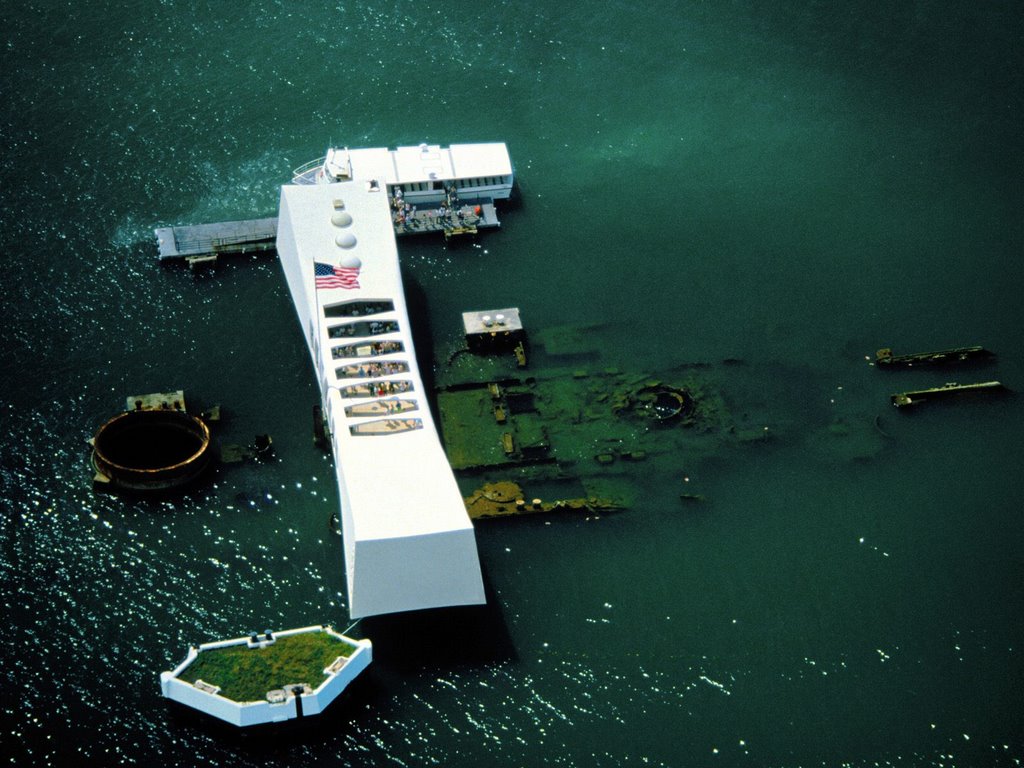
As you know, today is the 65th anniversary of the Attack on Pearl Harbor. Over 2,400 Americans were killed in the attack on "Battleship Row" which led to the US entering World War II. The intent of the attack was to destroy 3 aircraft carriers, none of which were in the harbor that day and were spared, leading to the US victory in the Pacific. In spite of the attack being a surprise, many servicemen fought bravely to defend their country. Almost half of the casualties were from the explosion and sinking of the USS Arizona, which today serves as an undersea grave and memorial. A total of 18 ships were sunk that day including 5 battleships. Of the other 4 battleships, all but the USS Oklahoma were repaired and returned to service. Let's remember this day "that will live in infamy" (President F.D.Roosevelt) and honor those who fought bravely and lost their lives to defend our country.

Tuesday, December 05, 2006

Life on a "Boomer"

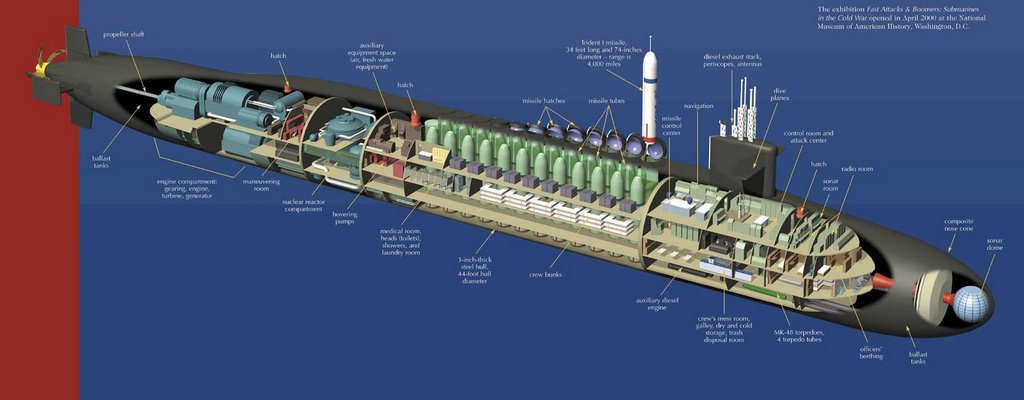
I posted some facts about the USS Louisiana a couple of weeks ago, so I thought I would follow up on what it was like to call the SSBN 743 home for a few months. The picture to the left is a cutaway view of an Ohio Class submarine, so called because the USS Ohio was the first one. The Louisiana was slightly different than the one pictured, but it still gives you an idea of the way the inside looked. Do you see where the crew sleeps? Yep, right there with the giant nuclear missiles! Every submariner goes through typically the same experiences, but they can vary some. Some Captains drill more than others. Sometimes when you are underway, you have an ORSE (Operational Reactor Safeguard Exam) to get ready for. My Capt. liked to drill, so everyday M-F at 6 am or so, the entire ship would be awakened by a "General Alarm" usually signifying a fire of some sort, or sometimes a call to "Battle-stations". Most of us were on an 18 hour day which means we were on watch for 6 hours and off for 12 before going back on. During that 12 hours, you had to do any co-lateral duties, study for quals or assist with any maintenance as well as get some sleep. I was in the Engineering Department, so I spent alot of time in the Engine Room. Most of my Battle-station assignments were there as well. An ORSE is really a way of testing the Engineering department so they know we will not cause a meltdown or something with the Nuclear reactor. The rest of the ship is really not involved much. I spent a total of 36 hours with no sleep (basically from the time the ORSE team arrived until they left). They drill you, test you, observe you, and watch while you are being trained. It is a very stressfull time. On a boomer, if you are not getting ready for an ORSE, then you are most likely on patrol. When on patrol, you are not allowed to be very loud. We ran "ultra quiet" most of the time and rarely ran drills as to not give away our position. Overall it was a good experience for me and I do not regret it. I have plenty more about life on a "Boomer" but I will save some for another time. I am just getting started!